Shoulder Arthroplasty (replacement) Surgery
What is shoulder arthroplasty?
Shoulder replacement surgery (also called shoulder arthroplasty) is a procedure in which the damaged or arthritic parts of the shoulder joint are removed and replaced with artificial components (prostheses) designed to restore smooth, pain-free motion.
-ff3518d.jpeg/:/rs=w:400,cg:true,m)
Who Needs Shoulder Arthroplasty?

Patients with Severe Arthritis
Arthritis in the shoulder (usually osteoarthritis, but also post-traumatic or rheumatoid arthritis) occurs when the smooth cartilage covering the ball-and-socket joint wears away. Over time, bone rubs against bone, causing:
- Constant or worsening pain, even at rest or at night
- Stiffness and grinding sensations
- Significant loss of range of motion
- Difficulty with everyday activities like reaching overhead, dressing, combing hair, or lifting objects
- Reduced quality of life and sleep disturbance
When arthritis reaches an advanced stage and the joint is significantly damaged, shoulder replacement is often the most reliable way to eliminate pain and restore function.
People With Failed Irreparable Rotator Cuffs
The rotator cuff is a group of muscles and tendons that stabilize the shoulder and allow you to lift and rotate your arm. In some cases — especially in older patients or after large tears — the tendons cannot be repaired or have already failed previous repair attempts. Without a functioning rotator cuff:
- The shoulder becomes unstable and weak
- Pain becomes chronic
- Patients often lose the ability to lift the arm overhead or away from the body
- Conventional treatments usually provide little or no lasting relief
In these situations, Reverse Total Shoulder Replacement is particularly effective. By changing the mechanics of the joint, it allows the large deltoid muscle to take over the work of the damaged rotator cuff, dramatically improving pain and function.
.jpeg/:/cr=t:0%25,l:0%25,w:100%25,h:100%25/rs=w:600,cg:true)
Other Common Reasons
- Failed previous shoulder surgeries
- Post-traumatic arthritis after fractures
- Certain types of severe shoulder instability combined with arthritis
Bottom line: If shoulder pain and limited motion are interfering with your daily life, work, sleep, or hobbies — and non-surgical treatments are no longer helping — you may be a candidate for shoulder replacement.
What are the Types of Shoulder Arthroplasty?

Anatomic Total Shoulder Arthroplasty
Anatomic total shoulder replacement (also called total shoulder arthroplasty) is designed to closely replicate your shoulder’s natural anatomy. The damaged ball (humeral head) is replaced with a metal ball, and the worn socket (glenoid) is resurfaced with a plastic component. This procedure is ideal for patients with advanced arthritis who still have a functioning rotator cuff. It reliably reduces pain, restores range of motion, and allows patients to return to daily activities and many recreational pursuits. Using modern muscle-preserving techniques and precise implant positioning, most patients experience significant improvement in comfort and function.
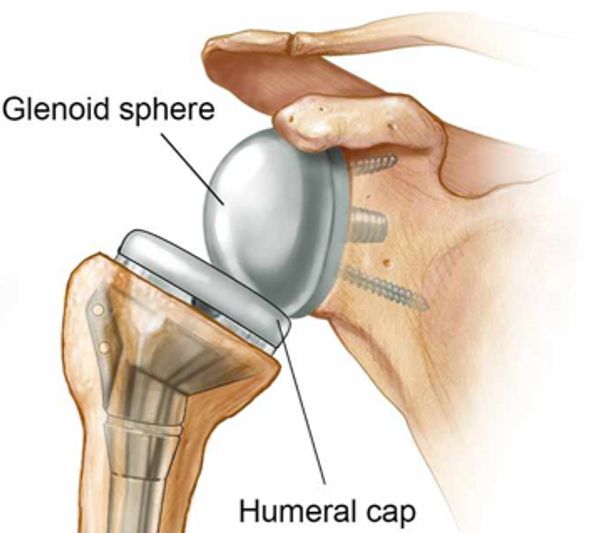
Reverse Total Shoulder Arthroplasty
Reverse total shoulder replacement is a sophisticated procedure that changes the mechanics of the shoulder joint to compensate for a damaged or absent rotator cuff. The ball and socket positions are reversed: a metal ball is attached to the shoulder blade (glenoid), and a plastic socket is placed on the upper arm bone. This design allows the powerful deltoid muscle to take over the work of the rotator cuff. It is highly effective for patients with massive, irreparable rotator cuff tears, severe arthritis with rotator cuff damage, complex fractures, or failed previous shoulder surgeries. Reverse replacement often provides dramatic pain relief and improved arm elevation when traditional options are not possible.
.jpeg/:/cr=t:0%25,l:0%25,w:100%25,h:100%25/rs=w:600,cg:true)
Shoulder Hemi-Arthroplasty (Half Shoulder Replacement)
Shoulder hemiarthroplasty (partial shoulder replacement) replaces only the ball (humeral head) portion of the joint with a metal implant, while leaving the native socket intact. This procedure is typically recommended for patients with severe fractures of the humeral head, certain types of arthritis where the socket is still in good condition, or younger patients who want to preserve more of their natural bone. It can provide excellent pain relief while maintaining good function with less surgical time and potentially faster recovery than a full replacement. Dr. Checketts trained to perform a special type of half shoulder replacement called the "Ream and Run" where the patient has no lifting or other restrictions after surgery!
Revision Shoulder Arthroplasty
.jpeg/:/rs=w:600,cg:true,m)
Revision shoulder arthroplasty is a complex procedure performed to replace or repair a previously implanted shoulder replacement that has failed, become painful, worn out, or loose. Common reasons patients need revision surgery include:
- Implant loosening or wear
- Persistent pain or stiffness after the original replacement
- Infection
- Instability or dislocation of the prosthesis
- Rotator cuff failure after an anatomic replacement
- Mechanical problems or bone loss around the implant
Revision shoulder surgery is technically more challenging than primary (first-time) replacement because of scar tissue, bone loss, and altered anatomy. It often requires specialized techniques, advanced implants, and bone grafting. The goal is always the same: to relieve pain, restore as much function as possible, and give patients meaningful improvement in their quality of life.
Advanced Techniques and Technologies
Ream and Run and Pyrocarbon Shoulder Replacements
For younger, active patients who want to return to a high level of activity without the typical lifting or impact restrictions of a traditional total shoulder replacement, I offer advanced bone-preserving options including the Ream and Run procedure and Pyrocarbon hemiarthroplasty.
Ream and Run
The Ream and Run is a specialized form of shoulder hemiarthroplasty in which the arthritic humeral head (ball) is replaced with a smooth metal implant, while the glenoid socket is carefully reamed into a smooth concave shape. The patient’s own bone is then allowed to heal and remodel against the metal ball. Because there is no plastic socket component, this procedure avoids many of the long-term risks and activity limitations associated with conventional total shoulder replacement.
Pyrocarbon Hemiarthroplasty
Pyrocarbon hemiarthroplasty uses a modern, ceramic-like pyrocarbon head on the humerus. Pyrocarbon is highly biocompatible, smooth, and has mechanical properties closer to natural bone and cartilage than metal. This makes it an excellent option for younger or highly active patients, as it is gentler on the native glenoid socket and reduces the risk of progressive wear.
Key Advantage
Both procedures are designed for motivated, active individuals who wish to return to sports, heavy labor, weightlifting, or other demanding activities without permanent restrictions. Many patients are able to resume higher levels of function than would typically be recommended after a standard total shoulder with no long term lifting or other activity restricitions!
.jpeg/:/cr=t:0%25,l:0%25,w:100%25,h:100%25/rs=w:600,cg:true)
Robotic Total Shoulder Arthroplasty
Robotic-assisted total shoulder replacement is an advanced, technology-enhanced procedure that uses a robotic system to help achieve exceptional precision during surgery. The robot does not perform the surgery — I do — but it provides real-time guidance, 3D planning, and unparalleled accuracy when positioning the implants.Key Benefits of Robotic Technology:
- More precise implant placement and alignment
- Better soft-tissue balance and joint stability
- Potentially faster recovery and less postoperative pain
- Improved long-term function and implant longevity
- Muscle-preserving approach with smaller incisions when appropriate
This technology is particularly valuable for both anatomic and reverse total shoulder replacements. It allows for highly customized surgical plans based on each patient’s unique anatomy, leading to more predictable and reproducible outcomes. I have been specifically trained in the latest enabling technologies — including robotics and augmented reality — and incorporate them when they offer a clear advantage for my patients. My goal is to combine world-class technical expertise with modern tools to help you achieve the best possible result with less downtime.
What Is the Expected Recovery Timeline?

Recovery timelines vary depending on the type of procedure, your age, and overall health, but most patients follow a similar path:
- Weeks 1–6: You will wear a sling for protection for approximately 4–6 weeks. During this time, we begin gentle range-of-motion exercises early in your recovery to prevent stiffness. Most daily activities around the house can be performed with your non-operated arm.
- Weeks 6–12: After the sling comes off (usually at 6 weeks), you will start a structured formal physical therapy program. Therapy focuses on regaining strength, flexibility, and endurance.
- 3 Months Post-Surgery: The majority of patients are able to return to most normal daily activities and light recreational pursuits by 3 months.
Faster Recovery Options
Thanks to advanced muscle-sparing techniques, many patients experience significantly less pain and faster return of function. Some individuals do not require a sling at all and can begin moving their shoulder much sooner.
For younger, active patients who undergo Ream and Run or Pyrocarbon hemiarthroplasty, there are typically no permanent lifting restrictions. These bone-preserving procedures allow many patients to return to sports, weightlifting, and demanding activities earlier and with greater confidence than traditional total shoulder replacement.
My goal is to help you recover as safely and quickly as possible while achieving the best long-term outcome. I provide individualized recovery plans and work closely with trusted physical therapists throughout the Tulsa area to support you every step of the way.